


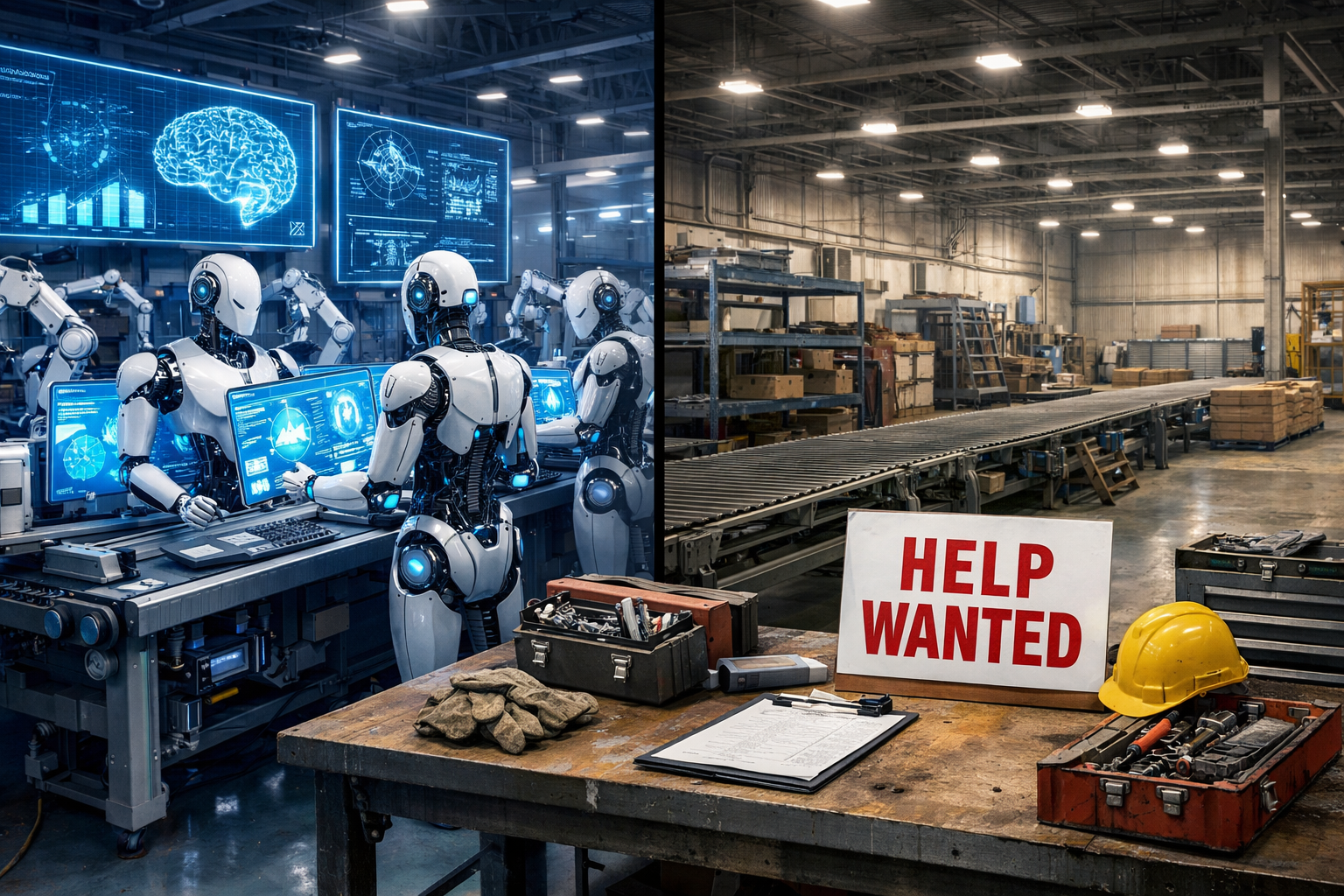
AI is commanding capital and headlines, yet employers from carmakers to hospitals report they cannot find enough people to perform the work that actually keeps economies running. The result is a paradoxical landscape in which tools proliferate while shortages of nurses, welders, technicians, drivers and care workers deepen across countries and sectors.
The Promise of Automation Meets a Stubborn Reality
For more than a decade, business leaders and policymakers have described artificial intelligence and automation as forces that would eliminate swaths of traditional jobs and displace workers at scale. Instead, many economies are experiencing the opposite pressure in critical occupations where tasks are physical, place bound or heavily regulated, and where technology is more complement than substitute.
Analysts describe a global labor market marked by simultaneously high demand for frontline and skilled trade roles and chronic difficulty filling them. The World Economic Forum’s Future of Jobs analysis finds that roles expected to grow most in absolute numbers include farmworkers, delivery drivers, construction workers, sales staff and food processing workers, along with nursing professionals and personal care aides. These are precisely the jobs that have proven resistant to full automation and that depend on stable pipelines of trained people.
Companies are adopting AI to optimize scheduling, predict maintenance, or automate routine back-office duties, but they still require humans to pour concrete, repair trucks, care for patients and install equipment. The danger, executives and economists warn, is that the gap between investment in tools and investment in people widens, leaving critical work undone and constraining growth.
Ford and the Auto Industry as a Warning
Few examples illustrate this tension as clearly as Ford Motor Company. Jim Farley, Ford’s chief executive, has repeatedly warned that the United States faces a serious shortage of blue collar workers just as automakers are retooling factories for electric vehicles and as demand for industrial and data center infrastructure accelerates.
Farley has said the country is already short roughly 600 thousand factory workers and 500 thousand construction workers, and that the auto sector alone will need about 400 thousand additional technicians over the next three years. These are not low paid positions at the bottom of the labor market; top tier technicians can earn six figure incomes, yet dealerships still struggle to fill open bays.
He and industry experts trace the problem to a breakdown in the skilled trades pipeline. High school automotive programs have declined over the past two decades, and many community colleges lack access to the latest electric vehicles and diagnostic equipment, leaving graduates underprepared for modern repair work. At the same time, the work is physically demanding and tool costs are high, discouraging new entrants even as vehicles themselves become more complex and software driven.
Ford’s challenge is not unique. As automakers reconfigure plants for batteries and EVs, they are competing for electricians, welders, industrial maintenance technicians and construction workers with data center operators, renewable energy developers and logistics firms. Reshoring and nearshoring strategies that bring production closer to end markets intensify the scramble for the same finite pool of skilled labor.
A Broadening Map of Shortages
Labor and talent shortages are not confined to autos. Surveys and forecasts show that by mid decade, employers across regions are struggling to hire in an array of sectors. ManpowerGroup’s global talent shortage research reports that more than seven in ten employers worldwide say they cannot find the skills they need, with shortages acute in healthcare, transport and logistics, automotive, IT, energy, manufacturing and consumer services.
In the United States, the Chamber of Commerce identifies healthcare, construction, manufacturing, transportation and logistics, and hospitality as sectors facing particularly severe worker shortfalls. Additional analyses highlight cybersecurity and education as areas where demand for qualified professionals outpaces supply. Across Asia Pacific, employers likewise report difficulty filling roles in information technology, healthcare and life sciences, energy and utilities, and logistics.
Forward looking estimates are stark. One study projects that global logistics and supply chain operations could require an additional 2.2 million workers by 2030, with current labor supply meeting only about 40 percent of that need. The same analysis notes that technology, healthcare, and e commerce are also on track to face critical talent gaps, driven by fast growth and training systems that are not keeping up with industry demands.
These shortages have knock on effects. When hospitality employers cannot staff hotels and restaurants, capacity is capped and service standards slip. When manufacturing plants and utilities cannot hire enough technicians, maintenance backlogs grow and expansion plans stall. Persistent gaps in healthcare staffing contribute to longer wait times, burnout and, in some settings, reduced access to services.
Why Work Is Going Unfilled
The roots of the current worker shortage reach beyond any single trend. Demographics, training systems, job quality and technological change all play roles in a complex mix that varies by country and sector.
An aging population is one fundamental factor. In many advanced economies, large cohorts of experienced workers are retiring from nursing, skilled trades and industrial roles faster than younger candidates can replace them. Tight immigration policies in some markets have further reduced the inflow of working age people who might otherwise fill gaps in construction, caregiving and agriculture.
Education and training systems have also lagged the needs of employers. Vocational and technical programs in fields such as automotive repair, precision machining and logistics have shrunk or failed to modernize, leaving graduates without exposure to the equipment and software now standard on shop floors and in warehouses. In fast evolving digital sectors, including cybersecurity and advanced manufacturing, the depth of specialized skills required can take years to develop, outpacing the capacity of schools and on the job training programs.
Working conditions contribute as well. Many of the hardest hit roles involve irregular hours, physical strain, exposure to health risks or limited flexibility relative to desk based jobs. Nurses cite burnout and staffing ratios that feel unsafe, drivers and warehouse workers face demanding schedules, and technicians often work in challenging environments. Even when wages rise, younger workers may prefer technology or office jobs that promise more predictable hours or remote options.
Perceptions matter. For years, public narratives emphasized the risks of automation and the decline of blue collar and middle skill roles, encouraging students and families to steer toward university pathways and away from trades. Now, as employers scramble for electricians, welders, mechanics and line supervisors, the talent pipeline that might supply them has thinned.
The AI Paradox
Against this backdrop, AI is reshaping white collar work at a rapid clip. Companies deploy generative tools to draft documents, answer customer queries and analyze data, hoping to boost productivity and reduce costs in knowledge intensive roles. Technology firms attract engineers with high salaries and stock compensation, while cloud providers and chipmakers build out data centers and fabrication plants that themselves require large numbers of electricians, construction workers and maintenance staff.
That dynamic creates what some executives describe as an AI paradox. Tools that automate cognitive tasks for office workers and software developers are scaling faster than society’s willingness and ability to train and reward people who do essential physical or hands on work. AI may reduce the number of analysts needed in a corporate headquarters, but it does not move a shipping container, install a turbine or feed a hospital patient.
In logistics and supply chains, for instance, operators are rolling out automation for routing and tracking, yet forecasts still show a significant shortage of human workers needed to run warehouses, drive vehicles and manage exceptions. In healthcare, AI can assist with documentation and diagnostics, but hospitals still need nurses, aides, therapists and technicians at the bedside and in clinics.
The risk, economists caution, is that investment patterns tilt too heavily toward digital tools without parallel commitments to workforce development in the occupations where technology is less substitutive and more complementary. That imbalance can exacerbate inequality: well educated workers in AI intensive roles capture productivity gains, while shortages in frontline jobs push up costs and strain services that everyone relies on.
Economic and Social Consequences
The immediate consequence of worker shortages is simple: work goes undone or becomes more expensive. When employers cannot hire, they reduce hours, limit production or pay overtime to existing staff, raising unit costs. Consumers experience longer waits for repairs, higher prices for services and occasional closures of facilities ranging from restaurants to hospital wards.
Over time, persistent gaps can dampen growth. Manufacturers delay expansions or select locations based on labor availability rather than purely on logistically optimal sites. Infrastructure projects stall or run over budget when contractors cannot assemble full crews. Governments struggle to staff public services, contributing to public frustration and eroding trust.
There are social implications as well. When care roles go unfilled, family members, often women, shoulder more unpaid caregiving, which can limit their participation in the workforce and reinforce gender gaps in earnings. Communities with chronic shortages of teachers, nurses or skilled tradespeople may find it harder to attract investment or retain residents, deepening regional inequalities.
By contrast, sectors able to recruit and retain scarce workers can gain strategic advantages. Companies that invest in training programs, apprenticeships and better working conditions position themselves to capture demand that competitors cannot serve. In some industries, firms are redesigning jobs to make them more sustainable, using automation to remove the most physically taxing tasks while raising pay and career prospects for those who remain.
What Employers and Policymakers Are Trying
Responses to labor shortages are emerging on several fronts. Many employers are raising wages and offering signing bonuses, but they increasingly recognize that pay alone may not be enough to rebuild talent pipelines that have eroded for decades.
Companies are expanding in house academies and partnerships with educational institutions. Ford, for example, is investing in its own training initiatives and collaborations with trade schools to ensure that mechanics learn on current EV platforms and diagnostic tools rather than outdated equipment. Logistics and manufacturing firms are building apprenticeship programs that combine classroom instruction with paid on the job training, hoping to attract younger workers who might otherwise bypass trades.
Governments and business groups are also pushing to revitalize vocational education and skills based immigration. In markets facing acute shortages, policymakers are debating reforms that would make it easier for foreign nurses, technicians and construction workers to enter and work, while simultaneously funding domestic training programs. Some countries are experimenting with targeted incentives to draw people into care work, such as loan forgiveness or wage subsidies.
The design of work itself is under review. Employers are testing shorter workweeks, more predictable schedules and expanded benefits for frontline staff, recognizing that improvements in job quality may be as important as pay in attracting and retaining workers. In sectors where tasks can be reengineered, automation is being deployed not to eliminate roles but to reduce physical strain, increase safety and create new career ladders that integrate technical and manual skills.
The Unfinished Work of Work
The tension between the rapid advance of AI and the stubborn reality of labor intensive work will not resolve quickly. Demographic trends and training bottlenecks suggest that shortages in healthcare, construction, logistics, manufacturing and skilled trades will persist through the rest of the decade absent significant shifts in policy and corporate strategy.
Executives like Ford’s Jim Farley have argued that countries need a reset in how they talk about and value blue collar and frontline jobs, framing them as essential, technologically sophisticated careers rather than second tier options. Economists add that investments in AI should be matched with investments in education, apprenticeships and job design in the occupations that keep physical systems functioning.
The world is discovering that algorithms alone cannot pour concrete, staff hospital wards, fix cars or deliver groceries. Even as software grows more capable, societies depend on millions of people whose work remains embodied, local and resistant to abstraction. As labor markets tighten and shortages spread, the unfinished business of how to train, reward and sustain those workers is becoming one of the defining economic stories of the age of AI.