
For nearly a century, the workplace was built on a simple, sturdy unit of measure: the job description. You were a “marketing manager” or a “systems analyst,” a collection of duties tethered to a headcount, overseen by a human manager who tracked your hours and your output. But according to a series of sweeping reports on the state of technology and labor, that foundation is being dismantled. We are entering the era of the “Great Rebuild,” a fundamental restructuring of organizational life where the distinction between human ingenuity and machine execution is blurring into a single, seamless “hybrid workforce”. The catalyst is no longer just a smarter chatbot or a faster processor. Instead, it is the emergence of what experts call a “silicon-based workforce”—autonomous AI agents and adaptive robots that don’t just assist humans, but execute complex, multi-step business processes from start to finish.
The End of the “Job”
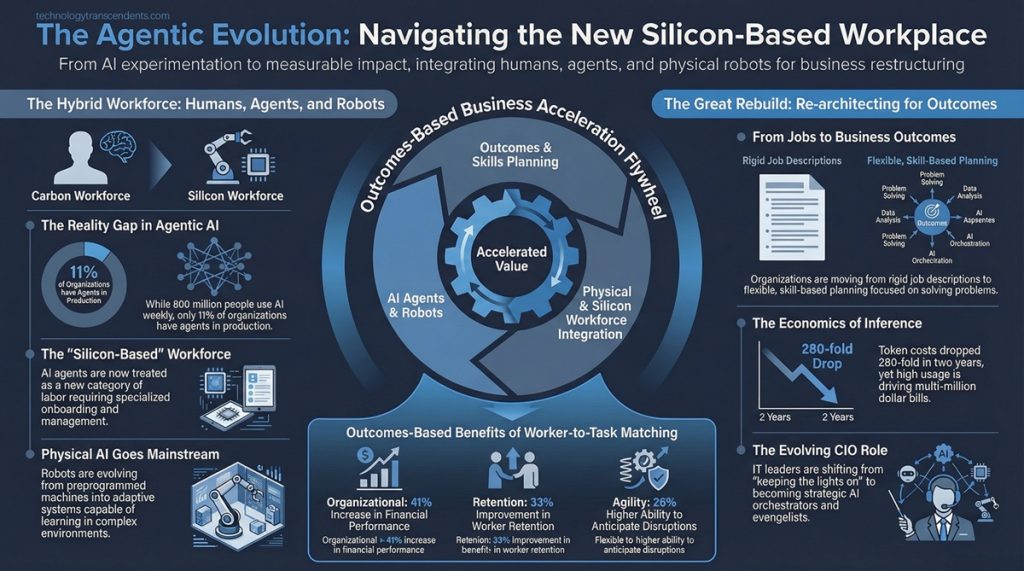
The most profound shift is happening not in the software, but in our heads. For decades, workforce planning was static. Today, it is becoming fluid. “What got us here won’t get us there,” notes the research. Organizations are moving away from job-based planning toward a model based on tasks and skills. This “fractionalization” of work allows companies to break down a traditional role into its component parts, matching specific tasks to whoever, or whatever, can do them best. The data suggests this isn’t a fringe movement. Only 19% of business executives now believe work is best structured through traditional jobs. Instead, they are looking at “outcomes.” In this new “agent-native” environment, a worker might not be given a list of chores, but rather a problem to solve, with the freedom to orchestrate a fleet of AI agents to achieve the result.
The Rise of the Agentic Worker
Last year’s tech craze was about experimentation; this year is about “the agentic reality check”. While 38% of organizations are piloting AI agents—digital entities capable of independent reasoning and action, only 11% have them in full production. The bottleneck isn’t the technology’s intelligence, but the “brownfield” infrastructure of the modern office. “Organizations are automating broken processes instead of redesigning operations,” the reports warn.
Consider “Alfred,” an AI agent developed by HPE to handle operational performance reviews. Alfred doesn’t just answer questions; it breaks down queries, conducts SQL data analysis, builds charts, and translates insights into structured reports. It is a “silicon worker” performing a composite process that previously required hours of human labor across multiple departments. This shift is forcing a merger of traditionally siloed corporate functions. At the biotech giant Moderna, the company has combined its HR and IT departments under a single Chief People and Digital Technology Officer. The logic is simple: If your workforce is now part-human and part-silicon, you need a single strategy to manage both.
Physical AI: Beyond the Screen
The transformation is not confined to the digital “white-collar” world. In warehouses and factory floors, the convergence of AI and robotics is creating machines that can “perceive, learn, and operate autonomously in complex environments”. At BMW, cars are now driving themselves through production routes without human drivers. Amazon recently deployed its millionth robot, coordinated by an AI model that improves fleet efficiency by 10%. These are no longer pre-programmed machines following a line on the floor; they are adaptive systems that learn from “digital exhaust” to navigate unpredictable spaces. The “humanoid frontier” is the next step. Projections suggest there will be 2 million workplace humanoids by 2035, designed specifically to navigate human-centric spaces—stairs, doorways, and narrow aisles—without requiring companies to rebuild their entire facilities.
The Infrastructure Reckoning
This “computation renaissance” comes with a staggering price tag. While the cost of a single AI “token” has dropped 280-fold in two years, overall corporate AI spending is exploding as usage scales. Some enterprises are facing monthly bills in the tens of millions of dollars. This is leading to an “infrastructure reckoning.” The “cloud-first” strategy that dominated the last decade is being replaced by a strategic hybrid approach. Companies are moving high-volume, consistent AI workloads back to on-premises data centers to control costs and protect intellectual property, while keeping the cloud for “bursty” experimentation. We are seeing the rise of “AI factories”, dedicated data centers built not for general computing, but for the specialized, high-energy demands of GPU clusters and liquid cooling systems.
The Supervisor’s New Role
If the machines are doing the “grunt work,” what happens to the humans? The reports suggest a shift toward “agent supervision”. In this model, human roles evolve toward compliance, governance, and innovation. Humans become the ethical guardrails, entering the workflow at “intentionally designed points to handle exceptions requiring judgment”. It is a shift from being the “doer” to being the “orchestrator.” However, this transition requires a new kind of “digital fluency”. New roles are emerging, AI collaboration designers, edge AI engineers, and prompt engineers, that didn’t exist five years ago. The CIO is evolving from a tech strategist into an “AI evangelist,” responsible for managing the “mixed silicon- and carbon-based workforce”.
The “Always Beta” Mindset
The most daunting aspect of this transition is its velocity. Innovation is no longer additive; it is compounding. The telephone took 50 years to reach 50 million users; generative AI reached 100 million in two months. This compressed timeline means the traditional playbook, studying a technology for a year before implementing it—is obsolete. “The time it takes us to study a new technology now exceeds that technology’s relevance window,” one CIO noted.
Success in 2026 and beyond will likely belong to the “agent-native” organization: those with the courage to redesign their entire operating model around the strengths of both human and machine. They are building organizations that are “always beta” by design—continuously evolving, learning, and rebuilding themselves in real-time. As we navigate this sea change, the goal is not to replace the human worker, but to create a new form of collaboration. The workplace of the future is a place where the “silicon coworker” handles the precision and the speed, leaving the human to handle the purpose and the soul.