
The history of modern work is often told as a sequence of technological breakthroughs. That is true, but incomplete. What matters more, particularly for those shaping organizations, is how each wave fundamentally restructured the nature of work itself: who does it, how it is coordinated, what skills are rewarded, and where value concentrates. Viewed through that lens, the past four decades reveal a clear progression across three major transformations: the personal computer era, the internet and cloud era, and the emerging age of artificial intelligence. Each did not simply improve productivity; it shifted the bottleneck of work, from access, to coordination, and now to cognition.
The personal computer revolution of the 1980s and 1990s marked the first great decentralization of work. Prior to this, computing power, and therefore decision-making support, was largely centralized in mainframes and controlled environments. The PC changed that by placing computational capability directly in the hands of individuals. This was not just a technological shift; it was an organizational one. Work that previously required layers of clerks, administrators, and intermediaries could now be executed by a single individual equipped with spreadsheets, word processors, and early enterprise software. The rise of tools like Microsoft Excel did more than accelerate calculations, it redefined roles, collapsing entire categories of manual and semi-skilled work.
In this era, productivity became closely tied to tool mastery. The most valuable employees were not necessarily those with the deepest domain expertise, but those who could most effectively leverage software to analyze, document, and present. Organizations responded by digitizing functions, finance, human resources, procurement, but largely in isolation. The result was the proliferation of functional silos, each optimized locally through technology, but rarely integrated end-to-end. Information improved; coordination did not. IT, while important, remained a support function rather than a driver of competitive advantage. Those who advanced were early adopters, individuals and firms that embraced digitization ahead of peers. Those left behind were the routine administrative layers that could not transition from manual to digital workflows.
The second transformation, driven by the internet and later cloud computing, addressed precisely this limitation. If the PC era digitized work at the individual level, the internet connected it. Suddenly, systems were no longer isolated; they became part of continuous, real-time networks. Information could flow across functions, organizations, and geographies. This fundamentally altered the structure of work from being tool-centric to process-centric. Work was no longer defined by what an individual could do on a machine, but by how effectively activities could be coordinated across systems.
Cloud platforms accelerated this shift by removing infrastructure constraints and enabling standardized, scalable services. Companies like Amazon Web Services exemplified this change, transforming IT from a capital-intensive function into a flexible, on-demand capability. The implications for organizations were profound. Functional silos began to give way, at least in principle, to cross-functional processes. Supply chains became integrated networks rather than sequential handoffs. Data moved from static reports to dynamic dashboards. Decision-making became faster, but also more dependent on system design and data integrity.
In this environment, the most valuable roles shifted again. Tool experts were no longer sufficient; organizations needed system thinkers, individuals who understood how processes interconnected and how data flowed across them. New roles emerged: product managers, data engineers, platform architects, and DevOps specialists. At the same time, many traditional IT operations roles declined, automated or abstracted away by cloud services. Work became measurable, trackable, and continuously optimized. Performance management evolved from periodic reviews to real-time monitoring. Yet this came with its own cost: complexity. As systems scaled, so did dependencies, integrations, and failure points. The bottleneck had moved from access to coordination.
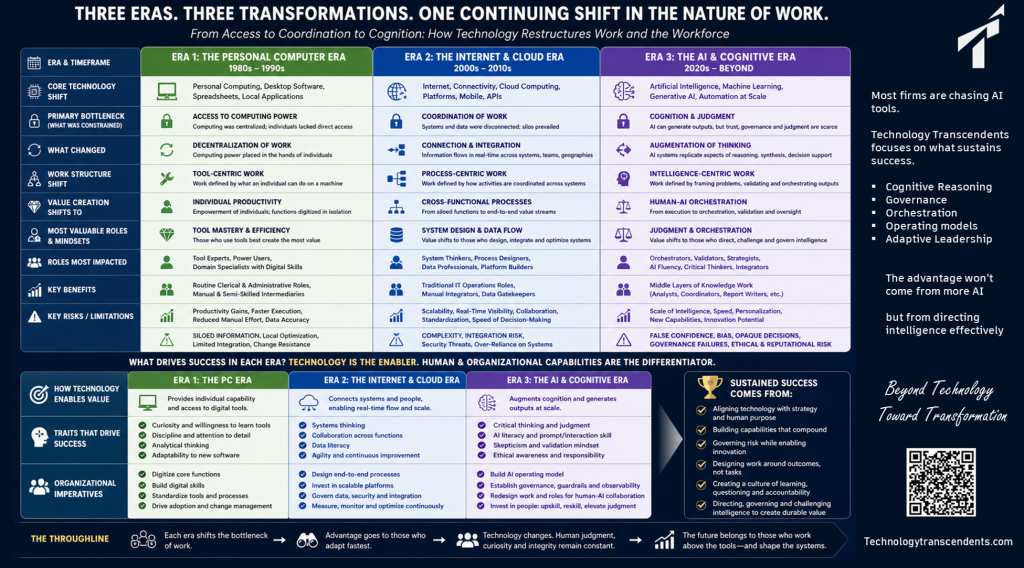
Now, a third transformation is underway, one that is often misunderstood because it appears, at first glance, to be a continuation of automation. It is not. Artificial intelligence represents a more fundamental shift: the partial automation of cognitive work itself. Where previous technologies enhanced human capability, AI begins to replicate aspects of reasoning, synthesis, and decision support. Systems like ChatGPT demonstrate that tasks once considered inherently human, drafting analysis, generating insights, even forming arguments, can now be performed, at least superficially, by machines.
This changes the nature of work in a way that is both subtle and profound. Tasks are no longer just executed or optimized; they are increasingly generated. A report is no longer written, it is prompted. A model is no longer built, it is suggested. The role of the human shifts from creator to orchestrator, validator, and integrator. This is where many organizations are beginning to struggle. The technical barrier to deploying AI has fallen dramatically. Models are accessible, APIs are abundant, and capabilities are improving rapidly. Yet operationalizing AI at scale introduces a new kind of complexity, one that is less visible but more dangerous.
The bottleneck has moved again, this time to governance, orchestration, and judgment. AI systems can produce outputs that are coherent, plausible, and often correct, but not reliably so. Errors are no longer obvious; they are subtle and embedded within otherwise convincing results. This creates a new risk profile. In previous eras, failures were visible, systems crashed, processes broke, outputs were clearly wrong. In the AI era, failure can manifest as false confidence: outputs that appear valid but are fundamentally flawed. The consequence is not just inefficiency, but misinformed decisions at scale.
Organizationally, this demands a new operating model. It is no longer sufficient to deploy isolated use cases or pilot projects. Many firms are already experiencing what might be termed “zombie AI initiatives”, projects that demonstrate initial promise but fail to scale, integrate, or deliver sustained value. The issue is not the technology; it is the absence of system-level discipline. AI must be treated not as a tool, but as an operational layer, one that requires clear governance frameworks, observability mechanisms, and orchestration capabilities. This includes understanding where AI is used, how decisions are influenced, and what controls are in place to validate outputs.
The impact on roles and workforce structure will be uneven. Contrary to popular narratives, the primary disruption is not at the lowest skill levels, but in the middle layers of knowledge work. Analysts, coordinators, and professionals whose roles involve synthesizing information and producing structured outputs are particularly exposed. Their tasks are precisely those that AI can augment or partially automate. At the same time, the highest-value roles, those requiring judgment, contextual understanding, and system-level thinking, are likely to become more important, not less. This will lead to a widening productivity gap between top performers and the average, as individuals who effectively leverage AI dramatically outpace those who do not.
Behaviorally, the shift is equally significant. Work is moving from knowing to asking the right questions, from doing to reviewing and validating, from experience to judgment under uncertainty. This creates a paradox: as output becomes easier to generate, understanding does not necessarily increase. Organizations risk becoming more productive but less thoughtful, more efficient but less accurate. The discipline required is not technical alone; it is cultural and managerial.
Looking ahead to the next decade, the organizations that succeed will be those that recognize this transformation early and respond accordingly. This means moving beyond experimentation to building a coherent AI operating model. Such a model integrates technology, governance, and workforce strategy. It defines how AI is deployed, how outputs are validated, how risks are managed, and how value is measured. It also requires investment in capabilities that are not traditionally emphasized: critical thinking, systems design, and cross-functional integration.
For individuals, the path forward is equally clear, if not easy. The advantage will not come from competing with AI on execution, but from working above it, framing problems, directing systems, and exercising judgment. This requires a shift in mindset as much as skillset. Technical literacy remains important, but it must be complemented by the ability to question, interpret, and synthesize.
Those who fail to adapt, both individuals and organizations, risk a familiar outcome, albeit in a new form. Just as the PC era displaced manual clerical work, and the internet era marginalized those unable to operate in connected systems, the AI era will leave behind those who rely on routine cognitive tasks without developing the capacity to oversee and challenge them.
The pattern, in retrospect, is consistent. The PC gave individuals tools. The internet connected those tools into systems. AI is beginning to reshape the thinking that underpins them. The next competitive advantage will not lie in access to intelligence, but in the ability to direct, govern, and challenge it effectively.