
Strategic Cognitive Development (SCD) is a specialist leadership and organisational capability programme designed to strengthen the quality of human thinking, judgement, and decision-making within technology-intensive environments. As artificial intelligence and automation reshape how work is performed, SCD ensures that the cognitive edge of an organisation, its capacity for strategic reasoning, adaptive thinking, and disciplined intuition, is treated as a managed asset rather than an assumed one. It is not a digital literacy programme. It is a rigorous, evidence-based intervention that builds what technology cannot replicate: the sophisticated human intelligence that leads, interprets, and ultimately directs automated systems toward competitive outcomes.
What It Includes
Cognitive Readiness Assessment A diagnostic baseline establishing where individuals and leadership teams currently operate across key dimensions including metacognitive awareness, decision quality under uncertainty, systems thinking range, and automation dependence. Results are mapped against role-specific cognitive demands to identify both risk areas and latent strengths.
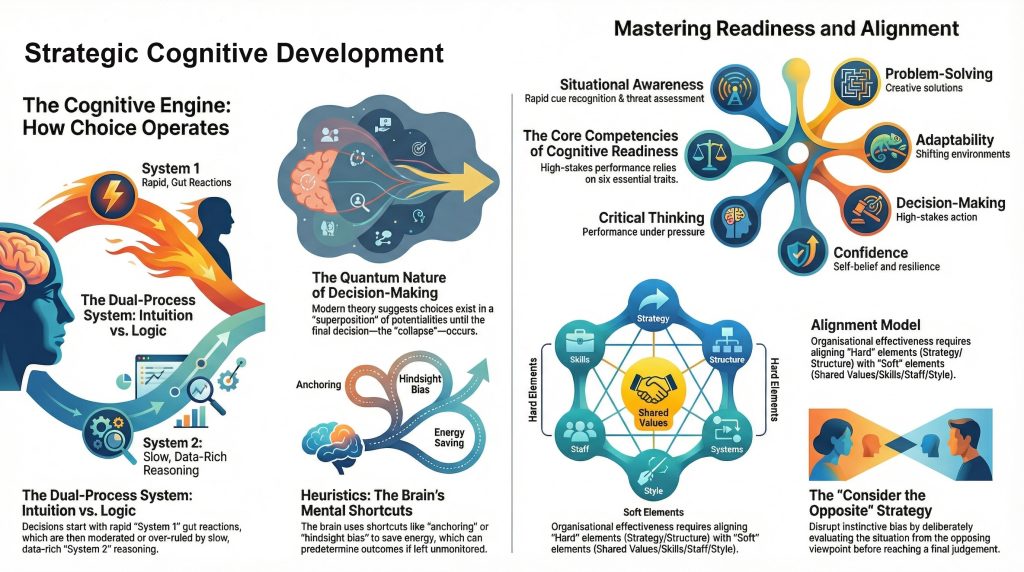
Decision Architecture Workshops Structured facilitated programmes drawing on Naturalistic Decision Making, Recognition-Primed Decision methodology, and Structured Analytic Techniques. Participants develop the capacity to make high-quality decisions in ambiguous, time-pressured, and data-saturated environments, and to know precisely when to trust, challenge, or override algorithmic outputs.
Systems Thinking and Complexity Navigation Intensive development in Cynefin-based sense-making, integrative thinking, and wicked problem framing. Leaders are equipped to distinguish between complicated and complex challenges, design adaptive responses, and maintain strategic clarity when conventional analytical tools reach their limits.
Cognitive Task Analysis and Knowledge Mapping A structured methodology for surfacing and codifying the tacit expertise held within an organisation’s most experienced professionals. This preserves institutional intelligence, makes mastery transferable, and protects against critical capability loss through retirement, turnover, or skill degradation.
High Reliability Team Protocols Team-level training in shared mental model development, structured dissent, pre-mortem analysis, and situational awareness maintenance, adapted from High Reliability Organisation research and Crew Resource Management practice into corporate and leadership team contexts.
Deliberate Practice Architecture Design and implementation of ongoing cognitive development regimes that build and sustain expertise through structured, feedback-rich practice rather than passive learning or experience accumulation alone.
Outcomes Expected
For the individual, SCD produces leaders who think with greater precision and confidence, who make better decisions under pressure and uncertainty, and who engage with AI tools as informed directors rather than passive consumers. Participants develop calibrated judgment , knowing not only what they think, but how reliable that thinking is and where it requires challenge.
For the team, SCD builds cohesive units with shared cognitive frameworks, structured communication habits, and the collective capacity to navigate complexity without fragmenting into individual opinion or defaulting to algorithmic consensus. Teams become more resilient, more analytically honest, and more capable of holding strategic tension productively.
For the organisation, SCD delivers a measurably more competitive workforce, one whose human capability compounds alongside its technology investment rather than diminishing because of it. The result is an enterprise where strategic oversight is genuine, institutional knowledge is protected, and the people inside the system remain its most sophisticated and adaptable asset.