
In the early 2010s, the public cloud was hailed as a revolutionary force: agile, scalable, and cost-effective. Leaders at companies like Amazon Web Services (AWS), Microsoft Azure, and Google Cloud Platform (GCP) promised a future where organizations could offload infrastructure burdens and focus on innovation. Fast-forward to 2026, and the narrative has evolved dramatically. While public cloud remains indispensable for certain workloads, it’s no longer seen as the default, “cheap,” or inherently secure solution for all operations. Industry reports reveal a seismic shift: enterprises are repatriating workloads to on-premises or hybrid environments at unprecedented rates, driven by escalating costs, security complexities, and the need for greater control. This reckoning isn’t a rejection of the cloud but a maturation of strategy, where “cloud-fit” thinking, matching workloads to the optimal environment, reigns supreme.
Drawing from recent analyses by firms like Broadcom, IDC, and Gartner, this article explores the forces reshaping cloud strategies. For executives, the implications are clear: ignoring this pivot risks financial overruns, compliance pitfalls, and competitive disadvantages. Instead, embracing a hybrid, disciplined approach can yield 30% to 60% cost savings and enhanced resilience.
The End of “Cheap” Cloud: From Pay-As-You-Go to Bill Shock
The allure of public cloud’s pay-as-you-go model has faded as organizations grapple with what experts call a “pay-for-everything” reality. Cloud infrastructure spending now ranks among the fastest-growing budget items, fueled by surging energy demands for data centers, hardware inflation, and the compute-intensive nature of AI workloads. Broadcom’s 2026 predictions highlight a 70-80% spike in DRAM and high-bandwidth memory prices, with enterprises bearing the brunt. AI training and inference alone can inflate bills exponentially, as models require vast GPU resources that public providers price at a premium.
Hidden costs exacerbate the issue. Data egress fees—charges for moving data out of the cloud—create a “Hotel California” effect: easy entry, expensive exit. Overprovisioning, where unused resources accumulate, further drives waste; Gartner estimates 30-35% of cloud spend is avoidable. A Barclays survey found 83% of enterprises planning repatriation, with IDC corroborating that 70-80% repatriate data annually for cost predictability.
Repatriation, once viewed as a retreat, is now a strategic imperative. DataBank reports 86% of CIOs planning to move workloads back on-premises, achieving 40-50% lower total cost of ownership (TCO) for steady-state applications. Companies like 37signals and Dropbox exemplify this: the former saved $10 million over five years post-AWS exit, while the latter cut $75 million in two years by building in-house infrastructure. For predictable, non-elastic workloads—such as databases or analytics—on-premises or private cloud offers fixed costs without the “noisy neighbor” issues of shared environments.
Yet, repatriation isn’t wholesale abandonment. As CIO.com notes, it’s selective: organizations retain public cloud for bursty needs while optimizing elsewhere. The key? FinOps maturity. This discipline, blending finance and operations, uses real-time dashboards and automated tagging to align spending with business outcomes. In 2026, FinOps is non-optional, evolving to encompass AI/ML and SaaS costs, per the FinOps Foundation.
Security in the Cloud: Complexity, Not Inherent Flaws
Public cloud isn’t “insecure,” but securing it demands expertise that many lack. Gartner’s stark warning persists: through 2025, 99% of cloud security failures stem from customer misconfigurations, not provider shortcomings. Exposed storage buckets, over-privileged accounts, and inconsistent policies across multi-cloud setups create vulnerabilities. Cymulate’s 2025 report shows 61% of leaders unable to remediate cloud exposures effectively.
The shared responsibility model amplifies risks: providers secure the infrastructure, but customers handle data and access. Misunderstandings here lead to breaches; 99% are customer-attributable. AI exacerbates threats: attackers use machine learning for automated reconnaissance, targeting APIs, containers, and serverless functions at machine speed. Palo Alto Networks’ Unit 42 found over 90% of incidents enabled by misconfigs or identity lapses.
Geopolitical factors add layers: data sovereignty regulations like GDPR and DORA push sensitive data to “sovereign” clouds. Supply chain attacks, via third-party vendors, surged 25% year-over-year. In response, zero trust—never trust, always verify—has become standard. Identity-first controls, multi-factor authentication (MFA), and micro-segmentation reduce attack surfaces. Cloud Security Posture Management (CSPM) tools automate detection, with 77% of pros citing identity risks as top concerns.
Toward a Hybrid, Cloud-Fit Future
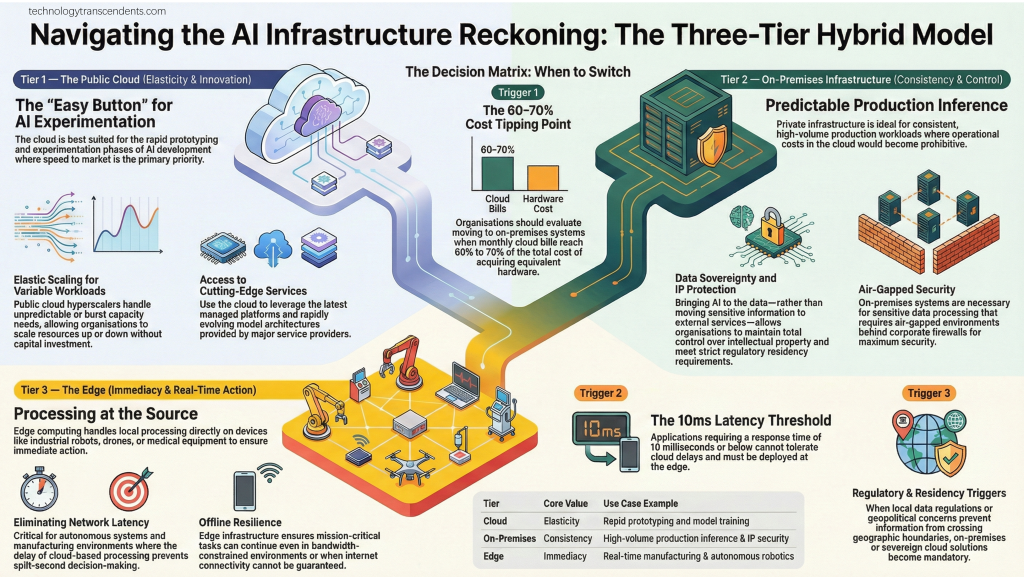
The 2026 cloud landscape favors hybrid strategies: 90% of enterprises will use hybrid by 2027, per industry forecasts. This isn’t retreat but optimization—public cloud for elastic, innovative workloads; private/on-premises for predictable, regulated ones. Microsoft describes hybrid as balancing compliance and residency needs. Over 70% run hybrid environments for cost and performance. FinOps integrates deeply, with 90% of practitioners managing SaaS alongside infrastructure. Tools like CloudHealth provide “Cloud+” visibility across hybrid setups. Zero trust unifies security: federated identities and continuous verification span environments. Edge computing and AI orchestration further refine hybrid, reducing latency for IoT and real-time apps. For leaders, success hinges on unified observability: platforms correlating data across clouds for proactive governance. VMware’s insights show repatriation scaling for AI resilience.
Leading Through the Reckoning
The cloud’s evolution demands a mindset shift: from default adoption to deliberate allocation. Executives must audit workloads, embed FinOps, and enforce zero trust to capture savings and mitigate risks. Those who adapt will turn cloud into a premium asset—secure, efficient, and aligned with business goals. In 2026, the winners aren’t all-in on public cloud; they’re masters of hybrid precision.